
Monday, November 2, 2020
"Ring Shout" by P. Djèlí Clark

Sunday, October 18, 2020
"Waste Tide" by Chen Qiufan

I'd heard Chen Qiufan talk at FutureCon, and happened to run across Waste Tide at a bookstore not long after. A cyberpunk tale set in a Chinese town built around e-waste recycling, the novel follows local and foreign characters as they attempt to contain or exploit an unexpected technological mutation.
This was a fairly absorbing read; I'm not entirely sure how I feel about it. The social elements were the most compelling part of the book for me—the "waste people" organizing, and the elites who profit off of their labor. The plot is somewhat diffuse, misdirecting—the first half or more of the book concern a double-edged deal with an green-washing American company that turns out to be a narrative macguffin—and characters exhibit a kind of ineffective agency. They do things, they make choices, but they're rendered largely irrelevant by larger events: more powerful factions, a massive tsunami, a kind of accidental Singularity.
Tuesday, March 24, 2020
"Japan Sinks" by Sakyo Komatsu

I feel like this might be in a similar category: having never lived under the shadow of earthquakes, volcanoes, tsunamis, merely reading about extreme versions of them felt a little distant and unreal for me. But I can imagine this book being shocking to someone more familiar with those disasters.
This is totally readable, though it feels more like a listing of disasters than any actual plot-based novel. The cast and scope is surprisingly large, with the result that only the events themselves do much developing.
What's the word for when something is both "dated", and "of a place/culture"? I can't quite place a lot about this novel, just because I don't know much about Japan generally, and specifically not about in the late '60s. It's odd to me how little the legacy of WWII was visible in here--possible it was just invisible but present throughout.
Saturday, January 4, 2020
"The Empress of Salt and Fortune" by Nghi Vo

The story they learn along the way, though—a deeper history of how the empress In-yo orchestrated a coup from her exile, and the secrets from that struggle that Rabbit has kept for decades—is an empire-spanning story of intrigue, deception, and violence, so it's fascinating to see it filtered in this very anthropological way. Each chapter starts with Chih describing objects of a different room, and then recording the oral history that they evoke from Rabbit.
Monday, December 30, 2019
Notable 2019 Reads & Re-Reads
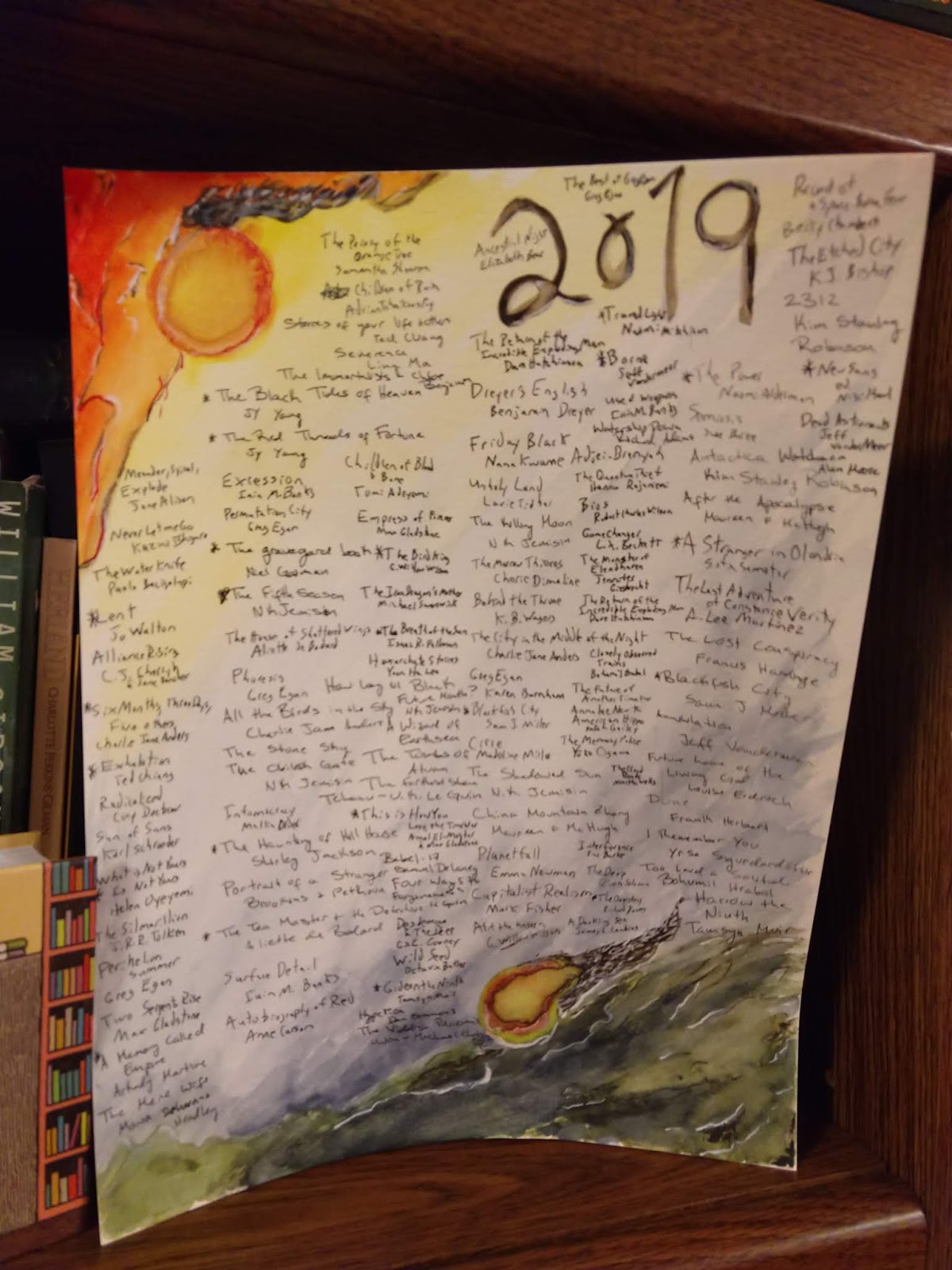
I didn't read or write quite as much as I'd planned this year: big life events (e.g. "marriage") and an occasionally-overpowering work schedule. That said, have ventured a bit more seriously into reviewing, and am working myself up to a few more serious projects.
My book-club schedule was also a bit more modest this year, but it's great to see them all going strong. Chicago's bookstore and lit scene continue to impress; the Chirbies were particularly good.
Wiscon was lovely, empowering, and thought-provoking, as usual. I didn't get to many SFF events in the latter half of the year, but caught some great stuff early on--including Maria Dhavana Headley on Beowulf, Nisi Shawl on Octavia Butler, Three Literary Perspectives on The Handmaid's Tale, and loads of content around One Book, One Chicago's selection—Do Androids Dream of Electronic Sheep?—including a great panel at DePaul.
Anyways, here's my list, and some brief notes. Happy reading!
Wednesday, September 18, 2019
"The Return of the Incredible Exploding Man" by Dave Hutchinson

Dave Hutchinson is a weirdly good writer, and I don’t quite know how to characterize The Return of the Incredible Exploding Man precisely because of that skill. Absorbingly readable, it’s nonetheless doing some very odd things at the meta level, things that left me with a definitive feeling of “huh” when it was all over.
Alex Dolan is a recently out-of-work science writer, a Scot, who is offered a lucrative book deal by an eccentric American billionaire, Stan Clayton. Reluctantly signing on, Dolan makes his way to the still-developing Sioux Crossing Supercollider in Iowa, Clayton’s pet project. Lightly enmeshed in the lives and politics of the science team and native Iowans, Dolan is also roped into light espionage by the British government, and faces an escalating series of threats from an unknown antagonist. Finally, three-quarters through the novel, Dolan must deal with a bizarre accident at the supercollider, and its aftermath.
Saturday, July 20, 2019
Review of Jo Walton's "Lent" @ the CHIRB

This was a fun book to review, primarily because it's so weird generically: you'd definitely want to shelve it as fantasy, but it doesn't sit very exactly into any of the categories it draws on. Alternate history, time travel, and historical fiction are all in the mix. As with a lot of Walton's work, there's a unique but winning kind of character study that powers a lot of theological/philosophical exploration.
It was a real treat to write something for the CHIRB--they're a great publication in their own right, and I really dig how much they're functioning as a kind of amplifier/attractor for the Chicago literary scene. Hopefully will do some more for them soon!
Wednesday, April 3, 2019
"A Memory Called Empire" by Arkady Martine

Nuanced critiques of imperialism are having a bit of a moment in
science fiction and fantasy. The simplistic, moustache-twirling
villain is in no danger of extinction, but an increasing amount of
speculative fiction is instead taking up more complex visions of
empire: as systemic, as seductive, and as power structures with which
even the most rebellious protagonists are complicit. How to reform—or
destroy—something as large as imperialism itself is the core
question in recent SF work like
Leckie’s Ancillary Justice
and Lee’s Ninefox Gambit,
while novels like Dickinson’s The Traitor Baru Cormorant
or Addison’s The Goblin Emperor
use it to reconsider the conventions of epic fantasy.
Arkady
Martine’s A Memory Called Empire
takes up these questions at at personal and governmental levels. It’s
a thoroughly diplomatic novel: there’s no separation between her
enchanting characters and the taut political maneuvering that drive
the plot. While
it is a space opera—set against the background of the
Teixcalaanli Empire, an expansionist interstellar power that has been
at relative peace for almost a century—the novel focuses less on
spaceships and aliens (both present) than it does on the bureaucratic
and interpersonal intrigue that steers the empire’s course, and
uses rich worldbuilding and personal detail to meditate on the
effects, large and small, of cultural hegemony.
Thursday, February 28, 2019
"The City in the Middle of the Night" by Charlie Jane Anders

The story takes place on January, a tidally-locked planet colonized by humans. In the narrow strip between perpetual day and perpetual night, humanity has adapted to the world's challenges. Our main characters meet as a revolution is brewing, travel to a rival city, make forays into the night, encounter some of January's original inhabitants, and generally have an exciting time.
No plot recaps, but possible spoilers below:
Monday, February 25, 2019
"Behind the Throne" by K.B. Wagers

Originally fleeing the constraints of the royal family while hunting for her father's killer, Hail Bristol has spent decades as a gunrunner among violent criminals. All that changes when a series of assassinations and conspiracies threaten the Indranan Empire, and Hail is brought home as the unexpected heiress apparent.
Sunday, February 24, 2019
"The Tea Master and The Detective" by Aliette de Bodard

The Tea Master and The Detective is set in the Xuya universe, a space-opera setting from a history where Chinese, Vietnamese, and Mesoamerican cultures predominate. A Sherlock Holmes homage, the novella (novellete?) follows a traumatized ship AI, The Shadow's Child, who plays a reluctant Watson to Long Chau, a "consulting detective" looking into a murder. Straightforward in its Holmes-structure, I found it most interesting for its focus on trauma, as well as all the snippets of Xuya worldbuilding we get.
The characters here are engaging, the work's main strength. That's unfortunate, since it's so short! Shadow's Child and Long Chau's interactions are great, odd imbalances of personality and power grafted onto the Doyle formula: Shadow's Child is a superhuman AI, but shy and traumatized; Long Chau has those Holmes-like powers of observation and deduction, but is secretive, shaped by the past in ways she doesn't want to acknowledge. I liked the way that Long Chau's abrasiveness feels genuine, largely unintentional, not overplayed, so Shadow's Child's opinion and interactions with her also feel more genuine.
Saturday, February 23, 2019
"The Marrow Thieves" by Cherie Dimaline

A post-apocalyptic indigenous YA story, The Marrow Thieves follows a teenage protagonist on a journey for survival across Northern Canada. In a world wracked by complex climate disaster, First Nations people find themselves hunted for their ability to dream, which everyone else has lost.
This was a very good read; I'm not much of a YA-reader, but wasn't put off by it—when the teenage-ness of the characters comes out in the later chapters, it's in very believably-confused attraction and rivalry. I think there's a limit to how well the world-building holds up to scrutiny—at club, we talked about "backpacker pragmatics" and issues of how the journey doesn't match up with calendar/map concerns very well—but the fairly episodic chapter structure keeps the story moving along, and the character interactions work.
Friday, February 15, 2019
"Unholy Land" by Lavie Tidhar
 This is a fun read! Alternate histories colliding, based around multiple potential states of the nation of Israel, with some clever meta-narrative and voice tricks going on. Quite rarely, for me, I found myself wishing it was longer.
Our protagonist, Lior Tirosh, is flying home to "Palestina", the Jewish nation established, in this timeline, in early 20th-century Africa (our Uganda). For reasons not immediately clear, Tirosh is experiencing a kind of slippage between worlds, half-remembering other histories. In Palestina, an old acquaintance turns up dead in his hotel room, catching Tirosh up in a conspiratorial tangle of nationalism, terrorism, and some kind of transdimensional plot.
I'm a sucker for a little bit of meta done right, and, if anything, I could do with more here. Tirosh has written or considered writing books with the same names and themes as Tidhar; one can't help but wonder if his very name, Lior, is a pun. That aside, one of my favorite elements of Unholy Land is the occasional jump through alternate worlds, where we catch glimpses of our history, Tidhar's fiction, and even stranger worlds—including scenes from Lovecraft's mythos.
I really love the way that Tidhar's play with multiple alternate histories allows him to punch up the "what if"—his nation of Palestina is tantalizingly close to our timeline, based on actual consideration of establishing a Jewish state in Uganda. Not content with the idea of thus preventing the Holocaust, Tidhar tosses around timelines that seem even worse, or at any rate radically different, and in all the worlds we visit focuses our attention on the xenophobic and even genocidal force that the Promised Land, no matter where situated, might prove to be. Investigator Bloom, the Palestinan intelligence agent following Tirosh, displays a callous violence that is explained, if not excused, in the terrifying reasoning that "they're not my people"; we're left with little doubt that the wall being constructed around Palestina is far more about ideological separation than any effective defense. It's a fairly biting critique of Israel's relationship with Palestine, albeit couched in a plausibly-deniable fantasy that would do the Strugatskys proud.
Thursday, February 14, 2019
"Friday Black" by Nana Kwame Adjei-Brenyah

There's really not a weak story here; they often feel worth reading on the sheer brashness of their Kilgore Trout-ish premises, but the writing is strong even in the quieter stories. Fantastic, science fictional, and magical realist techniques flesh out ideas and characters that are almost uncomfortably, clearly drawn from present reality.
"The Finkelstein 5", the opening story, launches the collection at full strength. In the wake of a brutal chainsaw-murder of five young black people by a white man who goes free, spontaneous incidences of black-on-white violence erupt while the victims' names are ritually spoken. Both a parody of miscarriages of justice and frighteningly plausible, there's both horror and a kind of bleak, surreal humor in the coverage of the trial. The narrator's storyline captures the confusion and pain around the double violence of the attack and acquittal, and his ability to "dial" his blackness up or down in a quantified way.
"Dreyer's English" by Benjamin Dreyer

It was a rare page of this book that passed without at least a chuckle on my part, but Dreyer doesn't feel like he's stretching (much) for laughs. The wit is baked-in.
Structurally, the book is a bit front-loaded—the latter third or so is rather list-y with specifics, though Dreyer keeps it interesting. The book shines most in carefully-drawn examples, illustrating the differences small changes in word choice or punctuation can make. Dreyer mounts a number of impassioned arguments for or against specific grammatical points without seeming fussy or overblown. If you are a writerly type of reader, or a readerly type of writer, one who has opinions on serial commas or the species of dash: this is for you.
Genre fans will also note a few lovely passages on Shirley Jackson—a comma in the opening paragraph of The Haunting of Hill House is, Dreyer says, his favorite bit of punctuation in written English—and the use of Gollum to indicate what manner of phrases may properly be said to be "hissed".
Sunday, February 10, 2019
"The Autobiography of Red" by Anne Carson

This was full of delights, so I'm glad I got around to it. It's a novel-in-verse, but to my fairly-untrained-eye not too heavy on formal poetic structures: no rhyming or fixed meter. Mostly it's structured as "long line/short line". The enjambment throughout made me really slow down; it allows the imagery to strike with more force than if it had been written as straight prose.
A re-telling of the myth of Geryon (a monster killed by Hercules), Autobiography of Red recasts the tale as a coming-of-age story. Geryon is still, perhaps, a monster—completely red, and bearing wings—but also just a boy, and the novel pushes playfully at our belief/disbelief in Geryon's physical monstrosity. Growing up on an unspecified island at some unspecified time (seemingly the latter part of the 20th century), Geryon falls in love with his Herakles, eventually running into him again in South America.
Saturday, February 2, 2019
"Surface Detail" by Iain M. Banks

This was a bit more work to get through, for me, than many of Banks' other works. Sentence-by-sentence, still lots of fun—the more attentively I read Banks, the more wordplay and cleverness jumps out at me—and the big ideas are good. However, the multiplicity of plots and view-points is a little overwhelming; what initially seems like three storylines proliferates and multiplies, with each point-of-view getting only fairly short textual chunks at a time. The result is a kind of attenuated feeling; there's so much not immediately obvious in each storyline (standard for Banks) that I just got a kind of collage of events, with things not really lining up until the last fifth of the book or so, when Veppers' real motivations become clear.
To real it back for a second to synopsis, Surface Detail is a Culture story: broad galactic space opera. The Culture itself is a multi-species civilization run primarily by Minds, highly advanced and typically ship-born AI. As it's basically a post-scarcity, hedonistic, space socialist utopia, tension in the Culture comes from its interactions with other civilizations—lower-tech groups that it sometimes attempts benevolent interference with, equivalent-tech groups that are potential threats, and "Elder" or "Sublimed" species that typically don't participate in galactic life, but may have powers far in excess of the Culture if they decide to do so.
Tuesday, January 22, 2019
"Infomocracy" by Malka Older

But that's getting ahead of myself. Infomocracy reads like a straight thriller, following two young activists/operatives in a near-future where the world has transitioned to "micro-democracy". Split into voting blocks of 100 thousand, people can now vote for a huge range of governments. Things are kept above-board by ubiquitous Information: an organization a bit like Google fused with Wikipedia and with a universal mandate. On the eve of an important election, with previous power blocs poised to tumble and rearrange, Mishima, Ken, and a handful of other characters are caught up in a complicated plot to subvert the voting process.
Wednesday, January 16, 2019
"House of Shattered Wings" by Aliette de Bodard

I didn't quite connect with this novel, and I'm kind of scratching my head as to why not. On a sentence-level, I like the writing, the premise is grabbing enough (fallen angels in interwar Paris), and I've generally quite liked De Bodard's SF.
The novel doesn't quite do enough world-building for me: I'm not clear on how "alternate" this Paris/Earth is, and I'm not familiar enough with the time & place to fill in the details. The plot had kind of random-feeling jags and loose ends, and none of the primary characters had much relationship.
Also, did astonishingly little with the theological or mythological--given that both seemingly-modern Christianity and actual walking talking angels coexist (including Lucifer), that seems an odd oversight at best.
Friday, January 11, 2019
"The Graveyard Book" by Neil Gaiman

Gaiman always strikes me as a bit of a balance: always clever, inventive, sometimes a bit cute, sometimes a bit gothy (for lack of a better way to put that), always a bit meta-interested in story, and I sometimes feel like he's about 2 degrees of tilt from going too far in any of those directions.
This is one is perfect.
Charming, but not cloying. Surprising, without feeling like it was manipulated to be so. Gaiman's core story and characters here are deft and natural-feeling, enough so that he can quietly insert some jokes (like the classic mummy/vampire/werewolf mashup, or the Jacks) without abrading the reader. The detail-work here is delightful, setting up a whole atmosphere of calm, shot through with vivid little snippets and a kind of horrific-comic tone, or comic-horrific, that might be Gaiman's signature move: in anyone else's hands it would collapse into Burton-esque vaudeville, but here the innocence of the protagonist, and the general plain goodness that surrounds him, allows us to run into murderers and monsters, ghouls and night-gaunts, in a way that keeps the horror, delighting fantasy, and quiet humor running simultaneously.
Saturday, November 10, 2018
Thoughts on "Venom" (2018)

Really the film's only strong feature is Tom Hardy, an unusually vulnerable Eddie Brock. Hardy plays up the character's slight dopiness rather than focusing on the tough guy that you can tell even this film thinks he is at times, keeping a strangely amiable, roll-with it attitude even as things get pretty bonkers.
But what a mess of a film. Pacing is all but nonexistent, with the alien symbiote visibly tentacle-possessing people within the first minute or two. It wants to be a shockingly violent movie, but is incapable of achieving that within the bounds of a PG-13 rating; it wants to capture the character Venom's gross-out cannibal comedy allure, but doesn't know how to achieve that beyond a few hard-to-hear voiceover lines; and most of all it wants to transform a monster we've barely had a chance to meet into an anti-hero we're rooting for, and fails quite remarkably. Venom's "change of heart" is the moment that this film really falls apart: not only is there no plot or visible development leading to this massive 180 in the character, but it's literally just stated, flat out, in a voiceover, "I will save this planet rather than destroy it"—incredibly easy to miss, and never explained or justified.
Saturday, May 12, 2018
Otherworld's "Down the Rocky Road and All the Way to Bedlam"

Sunday, May 21, 2017
Otherworld's "The Rogue Aviator"

Set in an alt-history version of the 1920s, the story revolves around the flying city of Olympus, a supposed techno-utopia threatened by sky pirates and its own descent into an oppressive military tyranny. The eponymous Rogue Aviator is Ellie McCloud (Moira Begale), a nobly-motivated bounty hunter with ties on both side of the conflict.
I'm continually impressed by Otherworld's project of bringing complex science fiction and fantasy stories to the medium of theater, and this was a fun show. Brief thoughts below:
New Millennium Theatre's "The Incredible Hank"

Their newest production is The Incredible Hank, a farcical super-hero tale written & directed by Alex B. Reynolds. Set in a super-hero saturated metropolis, it follows a file clerk (Mike Movido) with incredible strength who is drawn, against his will, into the world of super-crime and vigilante justice.
A fast, loud show with broad humor, The Incredible Hank had the audience erupting in laughter at every other line. Some quick thoughts below:
Saturday, May 13, 2017
Quick Thoughts on "Illyria: A Shakespearean Fantasy"

This was so much fun! I fear I can't put together a particularly coherent review at this hour, but it's such a limited run that I wanted to get down some impressions and encourage you to check it out.
Structured primarily around Twelfth Night (shipwrecked separated twins, cross-dressing shenanigans), Illyria also draws on A Midsummer Night's Dream (rom-com escapades in fairy-controlled woods) and The Tempest (magic & supernatural beings). Illyria plays up the fantastic elements to good effect and, perhaps more impressively, strips downs and blends some fairly tangled plots—the resulting script is lively and more consistently humorous than many straight adaptations of Shakespearean comedies I have seen, while maintaining the kind of multi-thread madcap quality that makes his comedies so enduring.
Sunday, March 19, 2017
Thoughts on Otherworld Theatre's "A Princess of Mars"
 Otherworld Theatre has just launched its second run of A Princess of Mars, their stage adaptation of Edgar Rice Burroughs' 1912 tale. Directed by Tiffany Keane Schaefer, adapted by Schaefer and Nick Izzo, the play is a rollicking adventure featuring inventive effects and stage combat.
Following the general outline of Burroughs' story—with some extremely effective changes that I'll get into below—A Princess of Mars is the story of John Carter of Virginia, a veteran of the Civil War mysteriously transported to Mars. In Burroughs' version of the red planet, it's a dying but habitable world populated by a wild assortment of alien cultures and creatures. Carter is quickly caught up in a variety of conflicts and escapades, eventually following in love with the titular damsel in distress.
 |
| Frank E. Schoonover's 1917 cover. |
But that's Burroughs, and, while this play is true to the broad outline of his work, it's very much its own creature.
Otherworld's production is, without reservation, a delight. I hadn't made it to any of their productions before—after seeing the House Theatre's production of Diamond Dogs, I'm belatedly kicking myself for not seeking out more of the SF/F performance art in Chicago—so I really wasn't sure what was in store. A Princess of Mars exceeded all my expectations: entertaining through and through, with a memorable cast, great costumes, tech, and stage combat, and a really delightful script.
Monday, February 27, 2017
Think Galactic- Diamond Dogs Outing
 This past Saturday, I joined some other members of Think Galactic for a theatrical outing—The House Theatre of Chicago's performance of Diamond Dogs at the Chopin Theater.
Diamond Dogs is a stage adaptation of the Alastair Reynolds novella of the same name: a kind of horror-survival story set in the far future, transhuman space opera world of Reynolds' Revelation Space universe. Saturday's production also featured a pre-show discussion with Reynolds himself, as well as playwright Althos Low (pen name for Steve Pickering & others) and director Nathan Allen.
I've been meaning to see more of the SFF-allied theater in Chicago, and I am *so glad* I made it out to see this—really quite a spectacle, not shying away even slightly from the science-fictional elements, and with some pretty brilliant tech—props, costumes, puppetry, light & sound—it pulled them off surprisingly well.
More discussion, and possible spoilers, below:
Sunday, January 8, 2017
Above-Average Space Spiders: Tchaikovsky's "Children of Time"

Elevator pitch: Uplifted jumping spiders battle a human-crewed generation starship.
YOU HAD ME AT JUMPING SPIDERS. Slightly more of a review, and a low possibility of spoilers, below:
Friday, December 9, 2016
Belated thoughts on Arrival
 Okay, it's been out for almost a month now, but I really wanted to get down some thoughts on Arrival, the recent film by Denis Villeneuve. An adaptation of Ted Chiang's 1998 Story of Your Life, the film follows a linguist and her team as they try to communicate with some decidedly non-human aliens.
A couple things to note right off the bat. Firstly, if you're an SF fan, you need to go see this. It's one of those incredibly rare science fiction films that doesn't just look science-fictional, it's actually powered by ideas. That's a very small family—Garland's Ex Machina last year springs to mind.
Secondly, if you haven't read Chiang's story, that is also a thing you should really do. Chiang is among the absolute best short SF writers, full stop, and Story of Your Life is one of those works that is already a touchstone for the field, tackling two heavy ideas—the relationship of language & cognition, and determinism & the nature of time—in a story that is still intensely human, and stylishly-written to boot.
Taylor Clark had a great piece on Chiang leading up to this film in the California Sunday Magazine, by the way. Recommended.
My thoughts below are pretty critical of the film, but please remember that I really enjoyed this film, I want to see more like it. It's an interesting case-study, though, in how adapting really science-fictional (i.e., cerebral) ideas from print to film is problematic, and it also showcases a few tendencies in current block-buster-y film that bug me, perhaps the more so because of all the things this does right.
Spoilers likely for both film & story below. Also, I should note that I saw this with other Think Galactic members, and a lot of thoughts below came out of our discussion.
Tuesday, November 29, 2016
Review: A Closed and Common Orbit

The good news is, whether or not you should read A Closed and Common Orbit (2016) is easily determined if you've read The Long Way to a Small Angry Planet (2014), the novel which precedes this. While structurally a bit different—Common Orbit has barely more than two characters, braids time-lines, and is essentially linear, where The Long Way is a meandering ensemble tale—the tone and intention of the two are very close. I find it very unlikely that one's reception of Common Orbit will vary much from The Long Way, with the possible exception that some might like (or dislike) that more time is spent with fewer characters.
Also, I should note that, although A Closed and Common Orbit follows immediately on the heels of The Long Way, plot-wise, it's by no means a sequel in the conventional sense. It could easily be read first, or as a standalone novel, with the caveat that having some of The Long Way's worldbuilding under your belt will make Common Orbit a little easier, albeit in a very minimal way. In her first novel, Chambers usually drops a lot of factoids about her alien species very quickly on meeting them, but the absence of this up-fronting of exposition in Common Orbit is hardly a weakness.
Plenty to love here; unfortunately, I find that to be outweighed by the novel's shortcomings. Possible spoilers, and many comparisons between the two novels, below:
Thursday, November 17, 2016
Secretly Crossing Invisible Lines: Hutchinson's "Fractured Europe" Trilogy
 |
| Yes, I also keep thinking that's David Boreanaz, Britney Spears, and... shadowed guy. |
"My grandfather writes of maps having a power over the land, and theorises that if an imaginary landscape is mapped in great enough detail, it will eventually supplant the actual physical landscape, as a wet cloth wipes chalk from a blackboard.I've really wanted to share something about Dave Hutchinson's "Fractured Europe" series, so rather than just reviewing the latest (and final?) installment, Europe in Winter, I'm going to do a bit of a review of the trilogy entire.
My great-grandfather, on the other hand, wrote of all possible landscapes underlying each other like the pages of a book, requiring only the production of a map of each landscape to make it real."
It seemed to me that Europe in Autumn (2014) flew weirdly low under the radar: it's an ambitious and well-executed novel, a genre blender that seems like it could be a real hit, but it barely blipped on my review & nominations-based "to-read" radar.
But! I'm glad I got around to reading it, as well as the sequels.
Set in the very near future, the books envision a Europe that is fragmenting into smaller and smaller microstates. Initially following Rudi, a chef who sort of stumbles into a world of espionage, organized crime, and mysterious activity, the weirdness in these books ramps up exponentially as parallel and virtual realities make themselves known.
I found these books a delight to read, for two main reasons. Firstly, these are a stylistic genre-departure for me: these are very grounded, unglamorous spy novels, essentially. Individual sections are well-drawn, character-focused; but the larger plot is often completely obscure, with both the reader and the point of view characters unsure from where, or why, danger is coming.
Against this world, and this is the second joy of the book, Hutchinson slowly doles out evidence of these deeply, seriously weird developments. He walks this very interesting line of making them huge and real, yet also refusing to let the story turn completely to the science-fictional elements. The world and its problems continue, just with some very big additions.
You can tell how hard I'm fighting spoilers. There will be some after the jump.
Tuesday, November 1, 2016
Review- A Taste of Honey

Set in the same world as Wildeeps, A Taste of Honey follows a young man of privilege who falls in love with a foreign soldier. Alternating chapters between the ten days of their frenetic romance and slices of Aqib's life years and decades afterwards, Wilson packs an astonishing amount of character and relationship into this slim volume, while also masterfully sketching the outline of a fantastic and magic-filled world. The world-building is delightful, the structure and plotting excellent, the characters immediately resonant, but what sticks with me most from A Taste of Honey is Wilson's use of language, both narratively—where he moves from invisibly descriptive to concisely insightful—and in his dialog, which captures an energy and a believable complexity almost unmatched in fantasy.
I'm going to do my best to avoid spoilers, but this is a pretty short work. Caution advised below if spoilers worry you:
Monday, October 24, 2016
Overclocking Clarke's Third: Yoon Ha Lee's "Ninefox Gambit"
 An unusually inventive military SF novel, I found Yoon Ha Lee's Ninefox Gambit very enjoyable in a very science-fictional way: I spent almost the entire novel building and revising this world in my head, and I'm still not entirely sure I've got it right. Like my last two reviews, I recommend it highly, with audience-specific caveats. Possible spoilers below.
Thursday, September 22, 2016
Review- Too Like the Lightning

And then, occasionally, one happens on a work that achieves its lofty goals, whose very scope is its prime recommendation. Here, we may use "ambitious" as unqualified praise, as a straightforward descriptor.
And such a work is Ada Palmer's "Too Like The Lightning", her first novel, released earlier this year.
Possible spoilers below:
Monday, August 29, 2016
Review- The Last Days of New Paris
(I've decided to start posting some reviews. I'm not taking particular care to keep them spoiler-free; neither am I making "recap" a goal.)
 So there are two things you need to know about The Last Days of New Paris. Firstly, it's by China Miéville. If you don't know who that is, don't start here. If you don't like his work, this probably won't be the one to change your mind.
Secondly, and this is something I kept forgetting even as I read a hardcopy, this is a novella. Or close enough, by today's standards—the main text is only about 160 pages. (Although—make sure to read the afterword, which is a short story in its own right.)
That's important to remember, knowing Miéville, and liking Miéville, as I do, as I hope you do—because shorter-length Miéville is a very different creature than sprawling, long-form Miéville. There is a plot here, and a setting. But there is not the sprawling, jumbled world-building of the Bas-Lag books. There is not the intricate, reversal-filled plot, the memorable cast, of The City and the City or Embassytown.
This a novella: it can execute a few things very well, and I'd argue that Miéville has done that here. More story-driven than a short story, less richly embroidered than a novel. Keep that in mind.

Secondly, and this is something I kept forgetting even as I read a hardcopy, this is a novella. Or close enough, by today's standards—the main text is only about 160 pages. (Although—make sure to read the afterword, which is a short story in its own right.)
That's important to remember, knowing Miéville, and liking Miéville, as I do, as I hope you do—because shorter-length Miéville is a very different creature than sprawling, long-form Miéville. There is a plot here, and a setting. But there is not the sprawling, jumbled world-building of the Bas-Lag books. There is not the intricate, reversal-filled plot, the memorable cast, of The City and the City or Embassytown.
This a novella: it can execute a few things very well, and I'd argue that Miéville has done that here. More story-driven than a short story, less richly embroidered than a novel. Keep that in mind.
Tuesday, August 2, 2016
Star Trek: Beyond the Steadicam

2.) Convince Idris Elba he is doing a PSA for Halloween-timed cavity prevention. Hand him a Freddy Krueger mask, wax teeth, and fluoride mouthwash. Record him gargling, advocating flossing techniques. Subtitle later.
3.) Where emotion is indicated, use that John Williams number from where Luke burns Vader's body.
4.) In post: lens flare, explosions.
Congratulations, you are now the proud director of a Star Trek film.
Subscribe to:
Posts (Atom)